
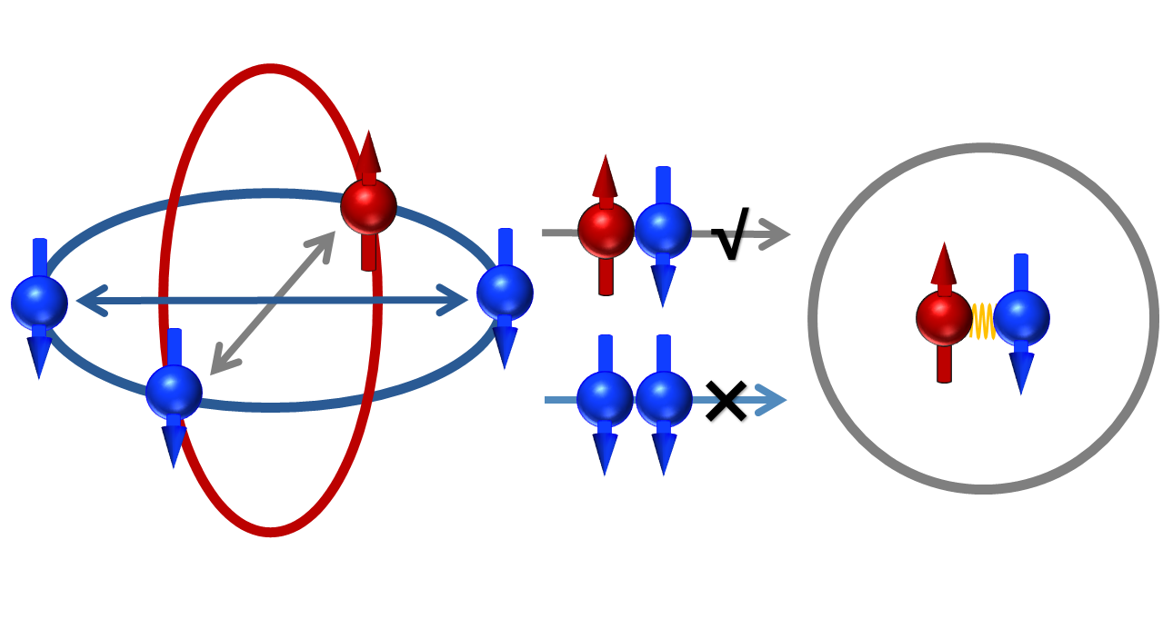
Altermagnets—a newly recognized class of magnetic materials combining antiferromagnetic order with momentum-space spin polarization—have attracted intense interest in condensed matter physics. Unlike conventional ferromagnets, altermagnets offer a pathway toward field-free, low-dissipation spin manipulation in spintronic devices.
In collaboration with domestic and international partners, the CCM team systematically studied longitudinal and transverse resistivity, Hall effect, and magnetoresistance in CrSb single crystals at low temperatures. The measurements reveal transport signatures markedly different from those of ordinary ferromagnetic or antiferromagnetic metals, indicating that altermagnetic order uniquely modulates carrier scattering.
Key findings
- Anomalous Hall effect sign reversal within the altermagnetic phase, consistent with predicted band splitting;
- Enhanced anisotropic magnetoresistance at low temperature, reflecting non-uniform spin-dependent scattering in momentum space;
- First-principles calculations confirming the altermagnetic ground state of CrSb, in agreement with experiment.
This work provides crucial experimental validation of the altermagnet concept in a real material system and opens new avenues for exploring the interplay between topological transport and spin-polarized currents.
The first author is a CCM doctoral student; corresponding authors are faculty members of the center. The research was supported by the National Natural Science Foundation of China, Zhejiang Provincial Natural Science Foundation, and the New Cornerstone Science Laboratory at Zhejiang University. The full paper is available on the Physical Review Letters website.
CCM will continue experimental and theoretical studies on strongly correlated electron systems, quantum magnetism, and emergent quantum materials. We welcome scholars worldwide to visit and collaborate.